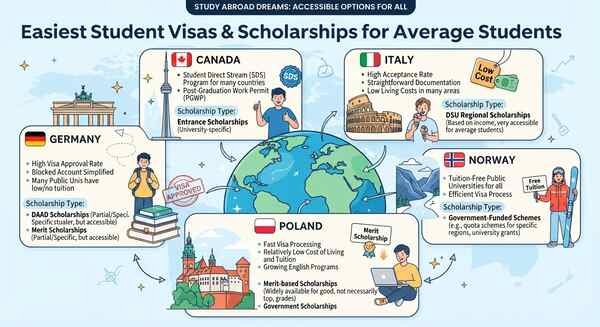
Which Countries Offer Easiest Student Visas and Scholarships for Average Students? Navigating international education pathways can feel overwhelming, especially when you are trying to balance your career dreams with financial realities. Many prospective learners worry that moderate academic grades or limited financial backgrounds will close doors to studying abroad. Fortunately, numerous global destinations welcome foreign national applicants by offering straightforward immigration department protocols alongside robust financial aid and scholarship opportunities. Whether you want to pursue an undergraduate, master’s degree, or PhD program, understanding how to match your profile with the right country makes all the difference. This comprehensive guide explores the top nations with high approval rates for student visas and accessible funding opportunities for average students.
Top Countries with High Student Visa Approval Rates
Finding a country with a high visa approval rate removes immense stress from the application process. Germany remains a leading destination because public universities charge little to no tuition fees, and its consular processing system is highly transparent. Canada is another popular choice, featuring welcoming immigration policies and robust post-graduation work permit options that allow you to gain valuable professional experience. Similarly, Australia and the United Kingdom (UK) offer structured study abroad frameworks, though applicants must carefully prepare their bank statements and financial proof. When preparing your paperwork, ensuring your passport validity matches embassy regulations and organizing your health insurance and police clearance certificates will significantly boost your success percentage. Beyond these traditional giants, countries like France, Italy, and various Eastern European nations also offer streamlined visa procedures, making them highly attractive for international students seeking hassle-free entry.
Furthermore, analyzing consular trends reveals that countries prioritizing international talent adjustments often relax stringent financial block requirements or introduce digital submission portals. For instance, European nations have increasingly digitized their appointment booking and document verification stages, reducing turnaround times significantly. Applicants must remain vigilant about changing policy updates, ensuring that their sponsor letters, local police certificates, and academic credentials meet exact embassy standards before final submission.
Fully Funded Scholarships Accessible for Average Students
Securing a fully funded scholarship does not always require a CGPA of 4.0 or a flawless academic record. Many government scholarships and institutional grants evaluate applicants holistically, taking into account extracurricular activities, leadership roles, a compelling statement of purpose (SOP), and strong recommendation letters. Programs like Turkey Scholarships, DAAD grants in Germany, and various developing countries’ scholarships specifically look for well-rounded candidates rather than just gradebook perfection. These awards typically cover full tuition waivers, monthly stipends for living expenses, accommodation, airfare, and mandatory health insurance, making higher education globally accessible. Average students can dramatically improve their selection chances by highlighting practical skills, volunteer work, and clear professional motivation in their applications.
When crafting your scholarship portfolio, your personal essay acts as your voice before the selection committee. Focus on articulating how overcoming personal or academic challenges shaped your resilience and dedication. Scholarship panels value authentic drive and community engagement immensely, often preferring a passionate candidate with average grades over a disengaged top-tier scorer. Additionally, securing powerful letters of recommendation from professors or employers who can vouch for your work ethic adds substantial credibility to your submission.
Financial Aid, Tuition Fees, and Cost of Living Management
Effective budgeting and smart financial management are vital when moving abroad for higher education. Even with a scholarship, managing your day-to-day expenses—such as rent, utilities, groceries, and public transit—requires careful planning. Many nations allow international learners to work part-time during semesters and full-time during holidays, helping cover living costs through local wages and campus employment. Opening an international bank account or utilizing digital transfer services ensures seamless handling of tuition fee installments and remittances from home, protecting your savings from volatile currency exchange fluctuations. Building a reliable emergency fund and tracking your daily spending using mobile budgeting applications will ensure long-term financial stability throughout your academic journey.
Managing living costs effectively also involves understanding regional economic variations within your study destination. While major metropolitan areas like London, Toronto, or Berlin offer extensive cultural and career networks, their housing markets can strain a student budget. Choosing mid-sized university towns or suburban housing options often reduces monthly rental expenses by up to thirty percent. Moreover, utilizing student discounts for public transportation, campus dining halls, and textbook rentals preserves capital for unexpected academic or medical contingencies.
Admission Requirements and Language Proficiency Testing
Meeting admission requirements and proving language proficiency are critical milestones in your academic journey. Depending on your destination, you may need to submit IELTS, TOEFL, PTE, or Duolingo English test scores, though some universities offer waivers if your prior education was conducted in English. Additionally, preparing academic transcripts, notarized degree certificates, and professional CVs or resumes must be done well ahead of deadlines. Utilizing test preparation materials, enrolling in online coaching classes, and registering early for your exam centers will ensure your scorecards arrive at admission portals on time. Securing competitive scores on standardized tests like the GRE or GMAT can further strengthen graduate application profiles for merit-based financial awards.
Preparing for standardized language assessments requires a structured study routine spanning several months. Dedicating daily time slots to reading academic journals, practicing listening comprehension exercises, and writing structured essays familiarizes you with the test format. Many online platforms offer diagnostic mock exams that highlight your weak areas, allowing you to fine-tune your preparation strategy before test day. Remember to check institutional code requirements early so your official score reports are dispatched directly to your target universities without delay.
Step-by-Step Application Process for International Admissions
Following a structured, step-by-step application process prevents costly mistakes and missed opportunities. Begin by researching and shortlisting universities and programs that align with your academic profile and career goals. Next, gather all required documents, including your SOP, academic transcripts, and financial documents, ensuring everything is properly translated and notarized if necessary. Create profiles on official university application portals, pay any required application fees, and track your portal status regularly. Once you receive your conditional or unconditional acceptance letter and official visa support documents like a CAS or I-20, you can proceed with booking your visa appointment, medical examinations, and flight tickets to begin your studies. Staying organized with a master checklist will keep your entire transition smooth and stress-free.
To execute this roadmap efficiently, establish a dedicated timeline starting at least nine to twelve months prior to your intended intake term. Break down major milestones into monthly goals—such as completing standardized tests by month three, finalizing your statement of purpose by month five, and submitting university portals by month seven. This proactive approach safeguards against unforeseen delays in document notarization, postal delivery, or consular appointment availability, ensuring you remain firmly in control of your international academic transition.
Official Scholarship & University Resources
-
DAAD German Academic Exchange Service Scholarship Portal—Deadline: Varies by program (typically October – January annually), currently open for upcoming academic cycles https://www.daad.de/en/
-
Turkey Scholarships Official Application Portal—Deadline: February 20 to March 31 annually, currently open for upcoming cycles https://www.turkiyeburslari.gov.tr/
-
Study in Canada Official Scholarship Portal—Deadline: Varies (multiple cycles throughout the year), Currently Open https://www.educanada.ca/
-
Campus France Official Scholarship and Admissions Portal—Deadline: December to March annually, Currently Open https://www.campusfrance.org/en
-
Study in Australia Official Government Portal—Deadline: Varies by institution and scholarship. Currently Open: https://www.studyinaustralia.gov.au/
Frequently Asked Questions (Latest Google People Also Ask)
Can average students with low grades get fully funded scholarships abroad?
Yes, many scholarships look beyond pure academic grades by evaluating your extracurricular involvement, leadership experience, and persuasive statement of purpose (SOP). Crafting a compelling narrative and securing strong recommendation letters can significantly elevate your application profile for international funding opportunities.
Which countries have the easiest student visa policies for international applicants?
Countries like Germany, Canada, and Australia maintain well-structured, transparent student visa systems with high approval rates for genuine applicants who provide complete financial proof, valid passports, and official university acceptance letters.
Do I need IELTS or TOEFL to study abroad on a scholarship?
While many top universities require standard English proficiency tests like IELTS, TOEFL, or PTE, several institutions waive this requirement if your previous degree was taught entirely in English or if you submit alternative language assessment proofs.
How much bank balance is required to show for a student visa?
The required bank balance varies by country and university, typically calculated to cover one year of tuition fees plus estimated living expenses as mandated by the respective immigration department guidelines.
Can I work part-time while studying on an international student visa?
Most major study destinations permit international students to work up to 20 hours per week during regular academic semesters and full-time during scheduled holidays, helping manage local living costs and gain practical work experience.
Conclusion
Embarking on your study abroad journey opens doors to exceptional global career opportunities and personal growth. By carefully preparing your applications and targeting accessible scholarships, you can achieve your academic dreams successfully.
Stay Connected!
Never miss a scholarship deadline! Join our channels for daily fully-funded opportunities & instant alerts.