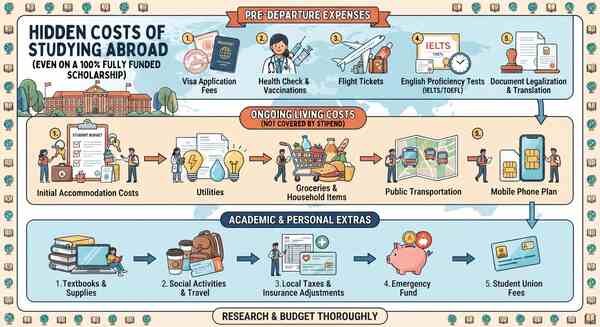
What are the hidden costs of studying abroad even on a 100% fully funded scholarship? Embarking on a journey of higher education in a foreign country represents a transformative milestone for any ambitious student. Securing a fully funded scholarship often feels like hitting the ultimate jackpot, completely alleviating the primary anxiety associated with exorbitant tuition fees. Aspiring scholars picture an academic odyssey where every single bill is magically taken care of by generous institutional sponsors or government bodies.
However, reality frequently introduces a sobering financial awakening once the acceptance letter arrives and packing begins. Even when international students receive prestigious financial packages covering full academic expenses, numerous unexpected financial obligations lurk beneath the surface. Understanding these overlooked financial factors ensures that scholars avoid sudden fiscal distress while pursuing their undergraduate degree, master’s degree, or doctoral program abroad. Proper preparation and comprehensive financial forecasting transform an otherwise stressful relocation into a smooth, rewarding academic adventure.
Tuition and Academic Fees: The Initial Misconception
When applicants review scholarship offer letters, they frequently assume that the term “full coverage” applies universally to every single charge appearing on the student account ledger. In practice, many institutional grants specifically target baseline tuition fees while explicitly excluding auxiliary charges billed by the university or college. International student admissions departments often separate core instruction costs from mandatory institutional overhead. Enrolled scholars frequently discover that they are personally responsible for auxiliary student union dues, recreation center fees, technology levies, and specialized laboratory deposits.
Furthermore, certain advanced graduate program tracks require specialized course materials or software licenses that fall outside the parameters of the primary financial award. Recognizing these subtle exclusions during the initial application process prevents unexpected out-of-pocket deficits during the first semester of study.
Visa, Immigration, and Consular Fees
Gaining official authorization to enter and reside within a foreign host nation involves a stringent admission and legal compliance procedure. Acquiring the required student visa demands substantial upfront capital that most funding packages completely fail to reimburse. Prospective scholars must navigate expensive bureaucratic steps, including biometric data collection, consular processing fees, passport renewal charges, and mandatory police clearance certificates. Additionally, many destination governments require certified document translations, apostille services, and official credential evaluations through authorized evaluation agencies.
Securing embassy appointments and traveling to regional consulates adds further transit expenses to the overall relocation budget. Failing to factor in these legal and administrative fees before the formal scholarship application submission can severely strain personal savings.
Mandatory Health Insurance and Medical Expenses
Healthcare compliance represents a non-negotiable prerequisite for maintaining legal enrollment status across nearly every prominent top university worldwide. While institutional awards frequently cover general academic expenses, comprehensive healthcare insurance is almost universally shifted onto the individual student. Host governments and academic institutions mandate specific insurance tiers that provide adequate coverage against emergency medical events, routine clinic visits, and specialized care. Private health plans or mandatory university insurance policies require substantial annual or semester-based premium payments.
Moreover, these policies often feature out-of-pocket deductibles, co-pays, and exclusions for dental or optical treatments. International scholars must meticulously review their health coverage terms to ensure that minor illnesses or unexpected injuries do not trigger catastrophic personal debt.
Airfare and Travel Logistics
Physical relocation to a foreign campus involves complex travel logistics that demand careful financial calculation and upfront spending. While select elite government scholarship programs include a one-time relocation flight allowance, many standard awards omit travel costs entirely. Students must purchase expensive international one-way or return tickets, often during peak travel seasons when airline pricing surges dramatically. Furthermore, airline baggage allowances rarely accommodate the extensive personal belongings, seasonal clothing, and academic reference materials required for long-term residency.
Paying for excess luggage weight or shipping supplementary cargo boxes introduces hundreds of dollars in unforeseen shipping expenses. Budgeting for airport transfers, public transit passes upon arrival, and potential transit hotel stays remains an absolute necessity for every arriving scholar.
Settling-In Allowance and Initial Accommodation Costs
Stepping off a long-haul flight into a brand-new country initiates an immediate wave of foundational living expenses. Securing safe accommodation near campus requires paying substantial upfront security deposits and advance rental payments that landlords demand immediately. Campus dormitories and off-campus private apartments rarely come fully furnished, forcing new arrivals to purchase essential bedding, kitchenware, and study furniture. Setting up local utility accounts for electricity, water, internet, and mobile services likewise requires initial activation fees and security deposits.
While some programs provide a modest settling-in allowance as part of their financial disbursement, these funds frequently arrive weeks after the student physically reaches the destination. Maintaining a dedicated emergency cash reserve ensures that scholars can comfortably navigate their first month without severe monetary anxiety.
Cost of Living Discrepancies and Stipend Gaps
Monthly stipend gaps represent one of the most insidious financial traps encountered by scholarship recipients living abroad. Living allowances calculated by sponsoring organizations are often based on outdated economic indices or conservative baseline models that ignore local inflation. Rapidly escalating housing markets and surging consumer prices in major student hubs drastically diminish the purchasing power of standard monthly stipends. When municipal inflation outpaces stipend adjustments, students face a painful fiscal deficit that forces them to seek supplemental income sources.
Navigating strict work permit regulations and competing for limited campus jobs becomes a stressful necessity just to cover basic grocery bills and utility expenses. Understanding the true local cost of living before accepting an award protects scholars from experiencing severe financial distress mid-program.
Academic Supplies, Technology, and Books
Advanced academic study demands reliable technological infrastructure and specialized learning materials that can strain even a well-planned budget. While institutional libraries offer extensive physical and digital resources, students must possess a dependable laptop, specialized software licenses, and high-speed internet. Technical programs often require expensive engineering software, statistical packages, or specialized hardware upgrades that are essential for successful coursework completion. Furthermore, purchasing required textbooks, academic journal subscriptions, and specialized stationery items accumulates substantial out-of-pocket costs over successive academic terms. Anticipating these recurring educational supply expenses allows scholars to allocate funds appropriately without compromising their primary academic performance or research objectives.
Currency Exchange Rates and International Transaction Fees
Financial liquidity and cross-border money management introduce hidden leakages that quietly erode student budgets over time. When home country currencies are converted into foreign host currencies, international banks impose steep wire transfer fees, intermediary charges, and unfavorable exchange rate markups. Relying on traditional credit cards or debit cards for everyday international transactions triggers continuous foreign transaction fees and ATM withdrawal penalties. Establishing a multi-currency digital account or opening a local bank student account upon arrival minimizes these recurring banking overheads. Scholars must carefully evaluate cross-border remittance strategies to ensure that their monthly stipends or parental financial support retain maximum value upon arrival.
Social Life, Networking, and Extracurricular Activities
Thriving in an international academic environment extends far beyond attending lectures, writing research papers, and studying in the library. Building a robust professional network and maintaining positive mental health require engaging in campus clubs, attending academic conferences, and participating in cultural events. However, dining out with peers, joining professional associations, purchasing networking event tickets, and exploring the host country involve discretionary spending. Social isolation often creeps in when students restrict themselves entirely from extracurricular activities due to hyper-conservative budgeting fears. Balancing frugal financial discipline with reasonable social participation ensures a holistic, well-rounded international education experience.
Frequently Asked Questions (Latest Google People Also Ask)
What expenses are typically omitted from a fully funded scholarship?
Fully funded awards generally cover institutional tuition fees and provide a standard monthly living stipend. However, they frequently exclude visa application fees, biometric processing, mandatory health insurance premiums, initial airfare, security deposits for housing, and textbook purchases. Students must plan for these out-of-pocket preliminary expenses to avoid immediate cash flow problems upon arrival.
How can students manage sudden cost of living increases while abroad?
To combat unexpected inflation and stipend gaps, scholars should build a robust emergency savings buffer prior to departure. Exploring legal part-time employment opportunities, utilizing student discounts, and practicing diligent monthly budgeting help bridge financial deficits caused by rising local living expenses.
Are international students allowed to work part-time to cover hidden expenses?
Most study destinations permit international students to work limited hours, typically up to 20 hours per week during active semesters and full-time during official semester breaks. However, visa regulations vary widely by country, and scholars must verify local immigration policies before accepting any employment offer.
Why do currency exchange rates impact scholarship budgets?
Sponsoring agencies usually transfer funds in specific currencies, and converting those funds into local host currency incurs conversion markups, wire fees, and fluctuating exchange rates. Using specialized international banking solutions or multi-currency platforms helps minimize these hidden transaction losses.
What documentation is required for student visa applications that costs money?
Visa application procedures frequently demand paid medical examinations, police clearance certificates, biometrics appointments, certified document translations, and passport renewal fees. These mandatory administrative costs must be paid entirely by the applicant prior to visa issuance.
Conclusion
Navigating an international academic journey requires thorough financial preparation that looks far beyond the appealing headline of a fully funded scholarship. By anticipating hidden relocation costs, insurance premiums, and living stipend discrepancies, scholars pave the way for a successful and stress-free academic experience.
Official Scholarship & University Resources
-
Fulbright Foreign Student Program: https://foreign.fulbrightonline.org/ (Application Deadline: Typically varies by country, usually between February and October annually—currently open for upcoming cycles)
-
Erasmus Mundus Joint Masters Scholarships: https://www.eacea.ec.europa.eu/scholarships/erasmus-mundus-catalogue_en (Application Deadline: Varies by program, generally between October and January annually—Currently Open for upcoming cycles)
-
Chevening Scholarships (UK): https://www.chevening.org/ (Application Deadline: November annually—Next cycle opening soon)
-
DAAD Scholarships (Germany): https://www.daad.de/en/study-and-research-in-germany/scholarships/ (Application Deadline: Varies by program, ranging from summer to autumn annually—Currently Open)
-
Australia Awards Scholarships: https://www.dfat.gov.au/people-to-people/australia-awards/apply-for-australia-awards-scholarships (Application Deadline: April 30 annually—Open for eligible partner countries)
Stay Connected!
Never miss a scholarship deadline! Join our channels for daily fully-funded opportunities & instant alerts.