Which Countries Give Free Monthly Pocket Money Along With Free Tuition for International Students? Understanding Global Opportunities for International Students. Pursuing higher education abroad is a transformative journey for ambitious international students seeking world-class academic exposure and career advancement. Navigating the complex study abroad landscape often reveals overwhelming tuition fees and prohibitive costs of living, making financial aid and scholarship opportunities essential components of academic planning. Securing a coveted spot at a prestigious university or college requires a thorough understanding of the admission process, strict eligibility criteria, and dedicated preparation.
Many learners dream of accessing quality higher education without falling into heavy debt, turning their attention toward nations that prioritize accessible learning. Global mobility programs and targeted funding opportunities have opened doors to individuals who demonstrate exceptional academic excellence and determination. Evaluating the economic viability of a target destination helps candidates align their personal career goals with international career opportunities. Exploring options where institutions subsidize educational costs or provide direct financial support can drastically alter a student’s financial trajectory. Understanding these structural dynamics allows scholars to map out a clear roadmap toward achieving their bachelor’s degree, master’s degree, or PhD aspirations.
Top Countries Offering Free Tuition and Living Stipends
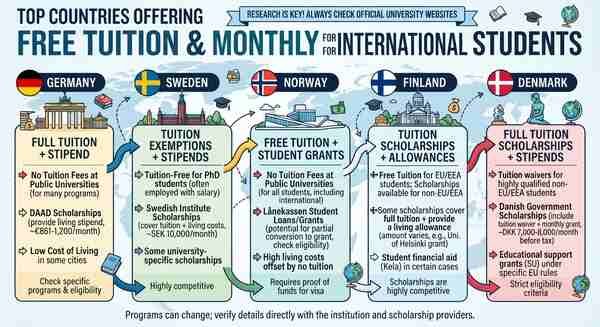
Finding countries that provide tuition-free education alongside financial stipends is a game-changer for scholars worldwide. Certain European governments view education as a public right rather than a commercial commodity, eliminating instructional fees for both domestic and overseas applicants. Beyond waiving university costs, some visionary nations offer living stipends or regular pocket money to help learners cover daily expenses like housing, food, and transport. This dual financial relief transforms ordinary study plans into fully sustainable academic adventures, reducing reliance on expensive student loans. Aspiring scholars frequently investigate various government scholarship schemes, institutional grants, and monthly maintenance allowances designed to ease financial pressure.
Evaluating a potential study destination involves examining not only the academic reputation of its institutions but also the realistic cost of living and available welfare systems. Governments implement these generous policies to attract global talent, foster multicultural campus environments, and drive long-term innovation. Securing a government scholarship often involves a competitive selection process, but the long-term rewards easily justify the rigorous application effort. Careful research into each nation’s specific funding mechanisms ensures that candidates apply to programs best suited to their financial and academic profiles.
Germany: The Powerhouse of Free Higher Education and Grants
Germany stands out globally for offering robust public universities that charge zero tuition fees for most undergraduate and consecutive master’s programs. International scholars only need to pay a nominal semester contribution, which typically includes public transport tickets and student union services. To support living expenses, the renowned DAAD scholarship program provides extensive financial grants, monthly stipends, and research funding for eligible applicants. Although education is free, students must demonstrate financial self-sufficiency through a blocked account containing a mandated minimum amount for their first year.
Securing a merit-based scholarship or a departmental assistantship provides additional financial relief, allowing learners to focus entirely on their studies. Whether pursuing a complex engineering master’s degree or a foundational bachelor’s degree, German institutions maintain rigorous academic standards combined with state-of-the-art laboratory facilities. Research opportunities abound across major cities like Munich, Berlin, and Heidelberg, encouraging active collaboration between academia and industry leaders. Navigating German administrative requirements requires patience, but the long-term professional payoff and access to Europe’s largest economy make the effort worthwhile.
France: Affordable Living and Government-Funded Allowances
France presents an exceptional environment for foreign learners, combining low administrative university fees with comprehensive state-supported welfare programs. The prestigious Eiffel Excellence Scholarship program attracts top-tier global talent by offering substantial monthly allowances, health insurance coverage, and travel grants. Additionally, the French government offers the popular CAF housing allowance, a financial subsidy that significantly reduces monthly rent for both local and international students. While public institutions charge modest registration fees rather than high commercial tuition, students benefit from world-class instruction across diverse academic disciplines. Managing daily life becomes manageable through part-time employment rights, allowing scholars to work up to 64 percent of the annual legal work hours.
Securing a student visa for France involves proving sufficient economic means and submitting a well-structured motivation letter to campus administration offices. The country’s rich cultural heritage, combined with affordable student canteens and subsidized public transport, creates an economically viable ecosystem for academic pursuits. Prospective applicants must demonstrate adequate language proficiency—either in French or English, depending on the chosen degree track—to maximize their classroom engagement and social integration.
Norway: Tuition-Free Learning for All Nationalities
Norway has long maintained a progressive educational model where public institutions charge no instructional fees for international students regardless of their nationality. While many neighboring European nations have introduced fees for non-EU students, Norwegian universities continue to champion equitable access to higher learning. Through student welfare organizations and government backing, scholars gain access to affordable campus housing, healthcare facilities, and recreational amenities. Financial support for living costs can be explored through institutional grants or part-time employment during the academic term, though living expenses in Scandinavia remain relatively high.
The Norwegian State Educational Loan Fund, known as Lånekassen, occasionally offers financial support pathways for specific international exchange programs and collaborative agreements. Studying in cities like Oslo, Bergen, or Trondheim immerses learners in a unique academic culture that emphasizes critical thinking, independent research, and egalitarian values. Prospective candidates must prepare thoroughly for the demanding winter climate, competitive admission cycles, and high housing demand in major university towns. Graduates from Norwegian institutions benefit from robust employment opportunities and progressive immigration policy frameworks designed to retain skilled international professionals.
Finland: Scholarships and Living Cost Support
Finland transitioned to charging tuition fees for non-EU/EEA students in recent years, yet Finnish universities offer extensive scholarship options that frequently cover up to 100 percent of instructional costs. Finnish higher education is internationally celebrated for its innovative pedagogical methods, student-centric classrooms, and exceptional technological infrastructure. To manage daily living expenses, international scholars can leverage Kela benefits under specific qualifying conditions, alongside student union discounts on transport, dining, and healthcare. Securing a tuition waiver requires submitting outstanding academic credentials, standardized test scores, and compelling motivational essays during the primary application windows. International degree programs span cutting-edge fields such as artificial intelligence, environmental science, digital health, and sustainable engineering.
Navigating the residence permit process requires proof of guaranteed funds to cover living costs, health insurance coverage, and university admission confirmation. Part-time work rights allow students to earn supplementary income, easing the financial burden of groceries, winter clothing, and accommodation. The welcoming Nordic culture and supportive campus communities make Finland an ideal destination for ambitious scholars seeking holistic personal and professional growth.
Navigating the University Application Process and Admission Requirements
Mastering the application process requires meticulous organization, attention to detail, and strict adherence to institutional deadlines across global universities. Candidates must carefully fulfill all admission requirements and verify specific eligibility criteria before submitting their credentials through centralized application portals. Demonstrating English proficiency through recognized examinations like IELTS or TOEFL is mandatory for programs taught in English, while German or French proficiency is required for localized tracks.
Academic dossiers must include certified transcripts, degree certificates, letters of recommendation from professors, and a meticulously crafted statement of purpose. Standardized tests such as the SAT, GRE, or GMAT may be required depending on the academic level and the prestige of the target institution. Tracking submission windows months in advance ensures that applicants have ample time to request official documents and secure notarized translations where necessary. Financial documentation, proof of health coverage, and passport validity checks form an integral part of the initial screening phase. Consulting professional education advisors or utilizing official university portals helps minimize errors and maximizes the likelihood of receiving an acceptance letter.
Essential Visa Requirements, Student Visas, and Work Permits
Securing a student visa is a critical milestone that transforms an institutional acceptance letter into a legally recognized international study journey. Applicants must navigate complex visa requirements by providing comprehensive financial proof, police clearance certificates, and medical examination results. Consular interviews require candidates to articulate clear academic objectives, demonstrate financial self-sufficiency, and prove their intention to return home or transition legally after graduation. Once settled abroad, students can leverage part-time work permits to gain valuable local professional experience while offsetting daily living expenses.
Post-graduation immigration policy frameworks in countries like Germany, France, and Norway offer extended residence permits for job-seeking graduates. Understanding the legal limitations on weekly working hours prevents academic burnout and ensures full compliance with local immigration laws. Timely renewal of residence cards and adherence to mandatory registration procedures within host cities prevent unnecessary legal complications. Comprehensive preparation for embassy appointments significantly reduces anxiety and accelerates visa processing times ahead of semester start dates.
Managing Living Costs, Campus Housing, and Healthcare Insurance
Balancing personal finances requires effective budgeting for living costs, secure campus housing, and mandatory healthcare insurance throughout the duration of academic programs. Securing university-affiliated accommodation early is vital, as private rental markets in major European student hubs experience extreme housing shortages. Comprehensive health coverage is legally mandatory for international students, ensuring access to emergency medical care, routine checkups, and pharmaceutical benefits. Daily expenses can be optimized by utilizing student discounts on public transportation, campus cafeterias, and cultural institutions.
Establishing a local bank account simplifies monthly transactions, rent payments, and tuition fee transfers without incurring excessive international exchange fees. Financial discipline and emergency savings buffers protect scholars against unexpected currency fluctuations or sudden price increases in grocery and utility sectors. Maintaining a healthy balance between rigorous academic schedules and part-time employment ensures overall well-being and sustained academic performance. Leveraging student support services on campus helps newcomers adapt smoothly to cultural adjustments and lifestyle changes in their host countries.
Frequently Asked Questions (Latest Google People Also Ask)
Can international students really study for free in Europe?
Yes, several public institutions in countries like Germany and Norway charge zero instructional fees for international students, though nominal administrative semester contributions usually apply. Candidates must still account for personal living expenses, mandatory health coverage, and initial visa processing fees.
Do tuition-free universities also provide living pocket money?
While universities rarely hand out direct universal living salaries, various government-backed scholarships, such as the DAAD in Germany or Eiffel grants in France, provide substantial monthly stipends to cover food, housing, and study materials.
What are the standard language requirements for studying abroad in Europe?
Programs taught in English require official test scores from recognized examinations like IELTS or TOEFL, whereas local language proficiency tests are mandatory if you choose programs conducted in German, French, or Norwegian.
How much money is required for a blocked account in Germany?
The mandatory financial proof for a German blocked account is adjusted periodically by government regulations to reflect realistic annual living costs, requiring applicants to deposit the specified sum prior to visa approval.
Can international students work part-time while studying abroad?
Most study visa regulations permit international students to work a designated number of hours per week during the academic term and full-time during official semester breaks, helping them supplement their monthly living budget.
Conclusion
Embarking on an international academic journey requires careful financial planning, strategic university selection, and thorough preparation for admission exams. Exploring nations that offer subsidized education and maintenance stipends empowers ambitious scholars to achieve their dreams without overwhelming financial stress.
Official Scholarship & University Resources:
-
DAAD Scholarship Portal (Germany): https://www.daad.de/en/study-and-research-in-germany/scholarships/ (Deadline: Various throughout 2026/2027; Currently Open)
-
Campus France Scholarship Directory: https://www.campusfrance.org/en/bourses-etudiants-etrangers (Deadline: Rolling / Varies by program, Currently Open)
-
Study in Norway Official Portal: https://www.studyinnorway.no/ (Deadline: December 1, 2026, for the Autumn 2027 intake)
-
Study in Finland Application Portal: https://www.studyinfinland.fi/ (Deadline: January 2027 intake cycles, Currently Open)
Stay Connected!
Never miss a scholarship deadline! Join our channels for daily fully-funded opportunities & instant alerts.