How to Check if an International Scholarship Agency or Website Is Legit or a Scam. Understanding the Landscape of International Scholarships and Financial Aid. Embarking on a journey toward higher education abroad is an exciting milestone for many ambitious students worldwide. Securing an international scholarship agency or funding opportunity can significantly alleviate the burden of expensive tuition fees and living costs. Millions of international students look for financial aid, merit scholarships, and need-based scholarship options every year to make their dreams of study abroad a reality.
Whether you plan to study in the USA, study in Canada, study in the UK, or study in Australia, understanding the financial ecosystem is vital. Navigating the complex university admission process requires careful academic counseling and thorough research into available funding opportunities. Unfortunately, the high demand for undergraduate admissions and graduate admissions has also attracted malicious actors attempting to exploit hopeful applicants. Finding authentic scholarship application portals and meeting strict eligibility criteria demands vigilance, especially when reviewing an application portal before any admission deadline arrives at top universities recognized in every reputable university ranking.
Common Red Flags Associated with Fake Scholarship Agencies
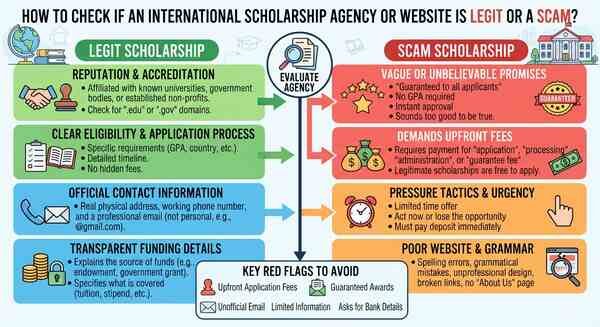
Navigating the web for funding can expose students to fraudulent entities mimicking legitimate organizations. One major warning sign of a scam is when an agency guarantees a scholarship in exchange for upfront payment or processing fees. Real scholarship providers never demand money to award funds. Be wary of suspicious emails, unverified websites, and aggressive pressure tactics urging immediate wire transfers or gift card payments. Scammers often use poor grammar, generic contact information, and unregistered business names to deceive applicants. If an agency claims secrecy or lacks a verifiable physical address, treat it as a critical risk factor. Always double-check every claim and ensure that any communication originates from an official domain rather than a free email service provider.
Verifying the Credibility of Scholarship Providers and Universities
Establishing trust requires rigorous background checks and careful verification of institutional credentials. Legitimate educational institutions and scholarship organizations maintain official accreditation and transparent organizational structures. You should always cross-reference website domains with official government registries, ministry of education directories, and university registrar pages. Consulting trusted consumer protection resources, Better Business Bureau ratings, and authentic student reviews can reveal whether an organization has a history of deceptive practices. Verifying contact numbers, physical headquarters, and official social media handles ensures that you are interacting with authorized representatives rather than impersonators.
Understanding Application Fees and Financial Transparency
Financial transparency is a cornerstone of any reputable educational organization or agency. While some universities charge a nominal, standard application processing fee directly through their secure payment gateways, fraudulent entities invent hidden charges, mandatory training fees, or service deposits. Legitimate organizations provide clear, itemized cost breakdowns and transparent refund policies. If an agency asks for sensitive banking details or requests money transfers via unsecured methods, step back immediately. Reviewing the legal compliance and consumer protection terms associated with any service helps safeguard your financial resources against exploitation.
Evaluating Official Government and Institutional Resources
Relying on official government portals and diplomatic missions is one of the safest ways to discover authentic funding. Prestigious programs such as the Fulbright Program, Chevening Scholarships, Erasmus Mundus, DAAD grants, and Commonwealth scholarships are managed directly through official government departments or recognized multilateral institutions. These programs publish clear guidelines, transparent selection criteria, and verified application timelines. By visiting official embassy websites and national education portals, students can bypass third-party risks and apply directly through secure, government-backed channels designed to support international academic mobility.
Protecting Personal and Financial Information Online
Digital safety is paramount when submitting applications to overseas institutions. Applicants often need to share sensitive data, including passport details, academic transcripts, and sometimes financial records. Ensure that any website you use employs secure HTTPS encryption and robust data privacy policies. Never share sensitive information such as social security numbers or banking credentials via unsecured messaging apps or unverified online forms. Utilizing two-channel authentication, strong passwords, and vigilant spam protection helps prevent identity theft and safeguards your confidential records from cyber threats.
Navigating Study Abroad Consultants and Admission Agencies
Many students choose to work with educational consultants and study abroad agencies to streamline their admission and visa processes. When engaging professional services, always request a signed service agreement outlining specific deliverables, counselor credentials, and transparent fee structures. Researching agency success rates, institutional partnerships, and student testimonials helps verify their professional standing. A trustworthy consultant will empower you to make informed decisions rather than forcing you into rushed commitments or guaranteeing admission outcomes that depend entirely on university discretion.
Frequently Asked Questions (Latest Google People Also Ask)
How can I verify if a scholarship website is authentic?
Checking the domain extension is a reliable first step, as legitimate institutions typically use official .edu, or recognized country-specific domains. You should also cross-reference the scholarship announcement directly on the official university website or government portal rather than relying solely on third-party referral links.
Do legitimate scholarship providers ever charge application fees?
Genuine scholarship programs almost never charge fees to apply or receive funds. While some universities require a standard application fee for admission processing, scholarship awards themselves are granted based on merit or need without requiring any financial contribution from the applicant.
What should I do if I suspect a scholarship scam?
If you encounter a suspicious agency or fraudulent offer, immediately cease all communication and avoid sharing personal or financial details. You can report the fraudulent activity to local consumer protection authorities, cybercrime reporting units, or the relevant educational ministry to protect other prospective students.
Are study abroad agents necessary to win scholarships?
Working with an agent is entirely optional, and many successful students navigate the application process independently using official resources. While professional counselors can provide helpful guidance, winning a scholarship depends strictly on your academic achievements, essays, and eligibility rather than agency representation.
How can I spot phishing emails claiming I won a scholarship?
Phishing emails often create a false sense of urgency, feature generic greetings, and request immediate wire transfers to cover administrative taxes or visa fees. Legitimate scholarship notifications are sent through secure official portals and never require upfront payments to release awarded funds.
Conclusion
Navigating international funding opportunities requires constant vigilance, thorough research, and a commitment to verifying every source. By prioritizing official portals and recognizing common scam indicators, students can confidently pursue their academic goals abroad.
Official Scholarship & University Resources
-
Fulbright Foreign Student Program: https://foreign.fulbrightonline.org (Currently Open, Deadline: Varies by Country, typically October 2026)
-
Chevening Scholarships UK: https://www.chevening.org (Currently Open, Deadline: November 2026)
-
DAAD Scholarships Germany: https://www.daad.de/en/study-and-research-in-germany/scholarships (Currently Open, Deadline: October 2026 – January 2027)
-
Erasmus Mundus Joint Masters: https://www.eacea.ec.europa.eu/scholarships/erasmus-mundus-catalogue_en (Currently Open, Deadline: January 2027)
-
Australia Awards Scholarships: https://www.dfat.gov.au/people-to-people/australia-awards/apply-for-an-australia-awards-scholarship (Currently Open, Deadline: April 2027)